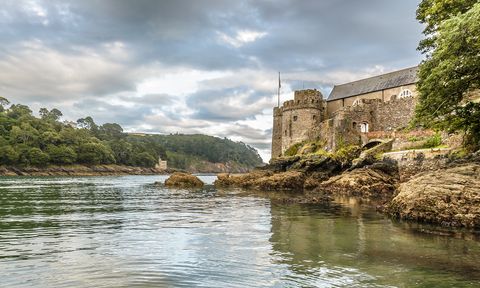
... 2002, if we're being precise, a group of friends thought it would be a great idea to put on an open-air Shakespearean production, and Dartmouth Castle seemed to be the ideal setting.
Of course, one of the most important decisions that had to be made was: What would they call themselves? So they ordered another round of drinks at the bar of The Cherub Inn (can you see where this is going?) and put their not inconsiderably endowed heads together.
Thus was born The Inn Theatre Company. Little did they know!
The full story of The Inn Theatre Company is to be found within the pages of this site. Have a look around, you'll be amazed at the number of people, over the years, who have been involved and helped make us what we are today.
Living and working in the South Hams, as the majority of the Company do, we feel it only right that we should try to put back a little of that which has been afforded us by the people who support us; whether that be audience or sponsors or volunteers.
To that end, we decided to take a percentage of our ticket sales and make a donation to a specific charity every year. The donation in 2009 is being sent to Children's Hospice South West & Macmillan Nurses.
In the past we have also made donations to other local bodies, amongst them The Dartmouth Film Society, St.Petrox Church & Dartmouth Caring.
Busy, busy, busy. We will be adding more pages to the website when time, and the rehearsal schedule, allow, but if you want to get involved, in any capacity, please, get in touch!
The Cherub Inn - where it
all began.
Last Updated 30/05/2010
Thanks for visiting - and remember! If you enjoy the theatre, come and watch or get involved!
WELCOME TO
THE
INN THEATRE COMPANY
ONCE UPON A TIME IN DARTMOUTH...
Paul Wonnacott &
David Fallow
in the first ever
Inn Theatre Production
'Twelfth Night'
The joys of open-air theatre!
MACBETH
August 3rd - 7th
Directed by Gil Garland & Jane Windsor -Smith
'The Scottish Play'; don't mention the name! Next year, join The Inn Theatre Company at Dartmouth Castle and see the only Shakespeare play with a villain as the 'hero'. Probably the most oft-quoted play in the canon, 'Macbeth' is a darkly atmospheric study of temptation, guilt, remorse, retribution, crime and punishment with, at its centre, the starkly ambitious figures of Macbeth and his wife.
Historically, the play is believed to have been written between 1603 & 1606, although scholars tend to favour the latter date. The links between King James, recently ascended to the throne, and the tragedy of Macbeth are evident and it is easily noted that, not long after a Scottish King came to the English throne, a play about Scottish history appeared.
We hope that you will come with us as we attempt something more dangerously dramatic than anything we have attempted before.
Directing this year will be Jane Windsor-Smith, who gave us the atmospheric production of 'The Tempest' in 2008 and, for the first time in the role of director, Gil Garland - Leonato in 2009's 'Much Ado About Nothing'.
Site designed and maintained by
bADoKapi
The Inn Theatre Company's
production of
in the open air at Dartmouth Castle
Tickets, as ever, will be available from the Tourist Information Office, in June, 2010
A boat. Not something you would normally expect to see on a theatre company web-site, but there's a reason. In 2009, after 'Much Ado About Nothing', not only did we donate to the South West Childrens Hospice and Macmillan Nurses but also to Dartmouth Sea Cadets so that they could buy a boat, not dissimilar to the one pictured. Our contribution went some way toward the final total.
MACBETH - Fact or Fiction?
Or, as is the case with the majority of Shakespeare’s ‘historical’ plays, a mixture of both? The truth behind many of the historical characters and incidents of which Shakespeare writes is, often-times, dry and, to be frank, pretty boring: and many of the sources he uses to construct an historical play are themselves less than reliable when it comes to facts. History is written by the victors!
So, was there an actual Macbeth? Lady Macbeth, King Duncan, Banquo? The short answer is yes; but many of the incidents, and some of the characters, that form the basis of Shakespeare’s most famous of tragedies, happened years apart or never existed in reality at all.
Gina Carter and Vernon Davis - Mr & Mrs Macbeth.
'Don't worry - you'll learn the lines in time!'
Shakespeare was a great ‘researcher’, pulling tales and people from what was written at the time, what had happened in recent history or, more importantly, taking real occurrences and using them to flatter and influence his patron; in this instance, King James I of England...also James VI of Scotland. Funny that...
Shakespeare’s main source for ‘Macbeth’ is Raphael Holinshed’s ‘Chronicles’ (themselves, it seems, semi-fictional) and several other historians of the time. ‘Macbeth’, the play, is severely contracted, chronologically speaking, and the main events at the outset of the play actually happened seventy or eighty years apart and had no real relation in fact. The murder of a King (Duncan in the play) was actually that of King Duff by Donwald who, according to Holinshed was ‘kindled to wrath by the words of his wife’, in 967 A.D. The historical Macbeth’s downfall actually happened in 1040 A.D. And the contraction is not only confined to chronology; the battle, as mentioned in Act1; Sc ii, is, in fact, an amalgamation of three historical set-to’s (also written of by Holinshed); the traitor Makdownald and his ‘skipping kerns’; Sweno (actually Sueno) and his Norweyan hordes (defeated by ‘brave Macbeth and Banquo’ in the play) and another historical invasion, by Canute and his Danes, to avenge the defeat of Sueno.
Gil Garland - in serious-director mode
Jane Windsor-Smith...with Mr & Mrs.
'...then lift the glass with both hands!'
Banquo (historically, Banquho) was an historical relative of James I and Shakespeare also played around a little with Holinshed’s ‘histories’. When Donwald killed King Duff he apparently had help from ‘...his trustie friends, amongst whom Banquho was the chiefest.’ Obviously, in Shakespeare’s version, history has been tinkered with and Banquo is an heroic and, ultimately, doomed supporter of Duncan. It transpires that Banquo was, in fact, never related to James I...but was, which is more likely, the friend - possibly the murderer?- that Macbeth employed to do his dirty work!
The whole play takes place over a period of several months, a veritable rush when you consider that Donwald had his servants kill King Duff (then drugged them and murdered them in a fit of righteous outrage...familiar?) and then takes his place on the throne for a period of several years before he, too, is eventually murdered.
Xowie, Lynne, Mary and Lel - just some of the Weird Sisters. We have a Coven you know!
But what of an historical Macbeth? Shakespeare did his research from facts that were available at the time and there was a Macbeth and his story is not dissimilar from the one in the play, but also completely different!
Macbeth's father Findlaech was ruler of Moray, at the northern tip of Scotland. Macbeth's mother's name is unknown, but she is variously said to have been the daughter of King Kenneth II or the daughter of King Malcolm II. In 1020, Findlaech was killed and succeeded by his nephew Gillacomgain. In 1032, Gillacomgain and fifty other people were burned to death in retribution for the murder of Findlaech, probably by Macbeth and allies.
The historical Mrs. Macbeth, called Gruoch, was the daughter of a man named Biote (Beoedhe), who was in turn the son of King Kenneth III "the Grim" who Malcolm II had killed to become king. (Some say that Biote was the son of Kenneth II instead.) She was originally married to Gillacomgain. Their son was Lulach the Simple. After Macbeth killed Gillacomgain, he took his widow Gruoch for his own wife, and raised Lulach as their stepson.
Centuries before Macbeth, King Kenneth MacAlpin, "founded Scotland" by uniting the Picts and the Scots. In this era, Gaelic custom required that the succession go via the male line, and that if an heir was not yet old enough to reign when the king died, the kingship went to whatever male adult was next in line. Kenneth MacAlpin's male line continued to King Malcolm II, who had at least two daughters but no sons, and he killed the last member of the male McAlpin line.
In 1034, Malcolm II was murdered at Glamis by his fellow warlords, possibly including his grandson Duncan. Then Duncan managed to kill his rivals and seize the throne. Duncan married Sibylla Bearsson and they had Malcolm and Donald "Bain".
Gil and Janie - studious is the look of the day; or is that puzzled?
These two are certainly NOT taking the
t-shirt's advice; the parts are too huge!
Macbeth allied with Thorfinn of Orkney, a Norseman. Thorfinn and Macbeth defeated and killed Duncan I in a battle in Elgin in August 1040. Thorfinn ruled northern Scotland, and Macbeth ruled southern Scotland. According to accounts, Macbeth was a good king, strict but fair, for the first decade of his reign.
In 1054, Earl Siward of Northumberland, who spirited Malcolm to England after Duncan's death, invaded Scotland. According to the Anglo-Saxon chronicle, he met and defeated Macbeth at the battle of Birnam Wood / Dunsinane (July 27). Most of Macbeth's army were killed, but Macbeth escaped. Siward's son and nephew were also killed. Macbeth continued to reign and was actually killed three years later by Duncan's son Malcolm.
Recognise any names there?
Lynne, who has been A/D on several of our productions, is taking charge of the movement and all things witchy. It promises to be a scarey experience...not Lynne, the witches!
Historically, there are too many glitches and discrepancies to make it a reliable reporter of what actually went on but what seems to be clear is that Shakespeare wrote ‘Macbeth’ to flatter the newly-crowned James I: but, as always, his deeper purpose seems to be to show us our own lives and make us think.
The key question that Shakespeare seems to ask is this: is human society fundamentally amoral? If so, then Macbeth is right, and human life itself is meaningless and tiresome.
Or do the hints of a better life such as King Edward's ministry, Malcolm's clean living, the dignified death of the contrite traitor, and the doctor's prescription for pastoral care, display Shakespeare's Christianity and/or humanism?
It's a dark play. The light of goodness seems still fairly dim. But evil always appeals more to the imagination, while in real life, good is much more fun. Is the message of Macbeth one of despair, or of hope? You decide.
2010 will be no different, inasmuch as we will, once again, be taking a percentage of the ticket sales and making donations to local organisations and charities. Actually, there is one small difference: we want to know if YOU know of any good causes to which we can contribute. We have already had several applications but there's always room for more.
It's simple. Just drop us a line, via the web-site 'Get In Touch' page - there's a link at the bottom - or write to our Company Manager:
Jane Windsor-Smith, 2, Lower Street, Dartmouth, TQ6 9AJ.
We hope to make the donations by the end of October/start of November.
Please, get in touch - we'd love to hear from you.
Although Dartmouth Shakespeare Week forms a great deal of the work we do as Company, it is certainly not the only time we appear on-stage!
We regularly appear at the Dart Drama Festival and have a presented several one-act collections, some especially written for the Company. 'Threesome' is an example of one such and 'Revealing Briefs' was a collection of short plays by other writers.
Now, after 'Macbeth', we are venturing even further into new territory: our first full-length play, written by Company member, Max Brandt.
'Dominion' tells the story of a young couple, Siobhan and Eddie, who are facing the most difficult time in their struggling marriage: Siobhan is dying.
But she is also determined that Ed will not be alone after she is gone, and sets about trying to find him a new partner.
It is the story of struggle to come to terms with, perhaps, the most frightening thing we face. Not without humour, it shines a light on us all.
STUNNING NEW
PICTURES ON
3, 4 & 5!